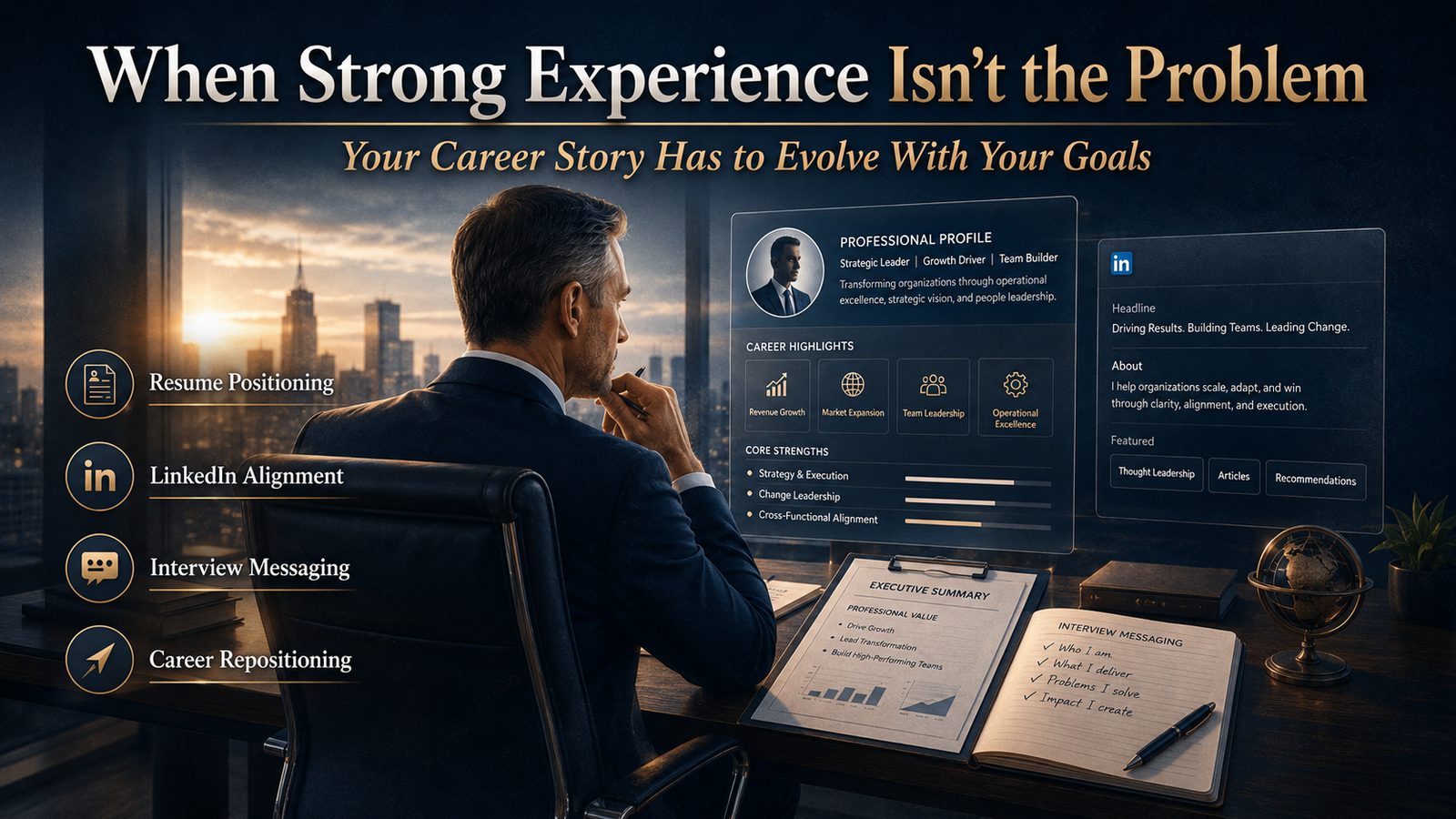
When Your Career Story No Longer Matches Where You Want to Go
Many executives and professionals reach a point where their experience is strong, but their career story no longer reflects where they want to go next.
They may have years of leadership, technical expertise, business impact, client service, operational responsibility, or industry knowledge. They may have contributed in meaningful ways, supported teams, solved problems, led change, and delivered results.
But when it is time to pursue the next opportunity, something feels disconnected.
The resume may no longer feel aligned.
The LinkedIn profile may not fully communicate current value.
The interview message may feel too broad, too dated, or too focused on the past.
The issue is not always a lack of experience.
Sometimes, the issue is that the career story has not evolved with the career goal.
The Resume May Not Be the Real Problem
Many executives and professionals begin a career move by saying, “I need to update my resume.”
Sometimes that is true.
A resume may need stronger formatting, clearer language, updated accomplishments, better keywords, or a more focused structure.
But in many cases, the resume is only one part of a larger issue.
The deeper question is whether the resume is telling the right story for the next move.
A resume that worked five years ago may not work for the direction you want now. A LinkedIn profile that once felt appropriate may no longer reflect your current level of responsibility, leadership, or expertise. Interview examples that made sense in a previous stage of your career may not fully support the opportunities you are pursuing today.
When your career goals change, your career materials and message must change with them.
Your Career Story Has to Evolve With Your Goals
Career growth often happens gradually.
You take on more responsibility.
You lead larger projects.
You develop new skills.
You support more complex business needs.
You move from individual contributor to manager, from manager to senior leader, from senior leader to executive, or from one industry or function into another.
But while the career evolves, the way you describe it may stay the same.
This is where many qualified executives and professionals get stuck.
Their experience has grown, but their message has not.
They may still be presenting themselves through an older lens. They may focus heavily on tasks instead of value. They may describe responsibilities without showing impact. They may include too much information that no longer supports the next level. They may understate leadership, strategy, decision-making, influence, or business outcomes.
The result is a career story that no longer matches the opportunity they want to pursue.
Why Strong Experience Can Still Look Unfocused
It is possible to have strong experience and still appear unfocused on paper.
This often happens when a resume or LinkedIn profile tries to capture everything instead of emphasizing what matters most.
Executives and professionals with long careers may struggle to determine what to include, what to minimize, and what to remove. Career changers may not know how to connect past experience to a new direction. Leaders preparing for higher-level roles may need to shift the focus from doing the work to leading, influencing, building, transforming, and delivering results through others.
Without clear positioning, even impressive experience can feel scattered.
A strong career story should help the reader quickly understand:
• Where you are headed
• What level of role you are targeting
• What value you bring
• What problems you are positioned to solve
• What strengths are most relevant now
• Why your experience matters for the next opportunity
When those pieces are unclear, decision-makers may not take the time to connect the dots for you.
Your career materials need to make the connection clear.
Signs Your Career Story Needs Repositioning
Your career story may need repositioning if:
• Your resume feels like a list of duties instead of a clear value message
• Your LinkedIn profile does not reflect your current goals
• You are applying for roles that match your experience but not receiving traction
• You struggle to explain what you want next
• Your background feels broad, complex, or difficult to summarize
• You have grown into a higher level of leadership, but your materials still sound too task-focused
• You are changing industries, functions, or career direction
• You are returning to the job market after a long tenure
• You have been impacted by a layoff, restructuring, or organizational change
• You feel more qualified than your resume makes you appear
These are not signs that your career lacks value.
They are signs that your value may need to be communicated more clearly.
Repositioning Is Not About Reinventing the Truth
Career repositioning is not about exaggerating experience or creating a version of yourself that is not accurate.
It is about presenting your experience through the right lens.
For example, a manager pursuing director-level roles may need to emphasize leadership scope, team development, operational improvement, stakeholder influence, and measurable results.
An executive preparing for a board-facing or enterprise-level opportunity may need to communicate strategic leadership, business transformation, change management, culture-building, financial impact, or organizational influence.
A professional changing industries may need to highlight transferable strengths, relevant accomplishments, and the business value of prior experience.
In each case, the facts remain the same.
The framing becomes stronger.
Your LinkedIn Profile Should Support the Same Story
Your resume and LinkedIn profile should not feel disconnected.
They do not need to be identical, but they should reinforce the same professional direction.
If your resume positions you for senior leadership but your LinkedIn profile reads like an outdated job description, the message becomes weaker.
If your LinkedIn profile highlights one career direction but your resume points in another, employers and recruiters may question your focus.
If your headline, About section, experience, skills, and accomplishments do not support the roles you want, your profile may not be helping you as much as it could.
For executives and professionals, LinkedIn is often part of the first impression.
It should support your positioning, strengthen your credibility, and help others understand the value you bring.
Your Interview Message Matters Too
Career positioning does not end with the resume and LinkedIn profile.
It also shows up in interviews, networking conversations, salary discussions, and executive introductions.
If you cannot clearly explain your value, your career direction, and the connection between your past experience and future goals, the job search can become more difficult.
Strong interview messaging helps you speak with more confidence and focus.
It helps you move beyond simply reciting your background.
It helps you explain why your experience matters, how you solve problems, how you lead, and what you are prepared to contribute next.
The strongest career moves are supported by alignment across your documents, online presence, and verbal communication.
How APEX Career Services Helps
At APEX Career Services, we work with executives and professionals who are often navigating meaningful career moments.
Some are preparing for advancement.
Some are transitioning after layoffs or organizational changes.
Some are changing industries or functions.
Some are returning to the market after a long tenure.
Some are pursuing senior leadership, executive, federal, academic, nonprofit, or specialized professional opportunities.
Many have strong experience, but they need help clarifying the story behind that experience.
Our work is not simply about creating polished documents.
It is about helping clients clarify direction, strengthen positioning, and develop professional materials that align with the next step.
That may include resume writing, executive resume development, LinkedIn profile writing, interview preparation, career coaching, salary negotiation support, federal resume services, or CV development.
The goal is to help each client move forward with stronger clarity, confidence, and strategy.
A Stronger Career Story Can Change How You Are Seen
When your career story is clear, your experience becomes easier to understand.
Your value becomes easier to recognize.
Your goals become easier to communicate.
Your resume, LinkedIn profile, and interview message begin working together instead of competing with one another.
You are no longer relying on others to figure out what you bring to the table.
You are helping them see it.
If your experience is strong but your career materials no longer reflect where you want to go next, it may be time to revisit your career story.
Your next move may not require starting over.
It may require repositioning.
APEX Career Services helps executives and professionals clarify their direction, strengthen their positioning, and move forward with a more aligned career strategy.
To learn more, visit www.ApexCareerServices.com.
Posted in Career Strategy & Development, Uncategorized